Air fryer, rice cooker or mini fridge: the quick answer
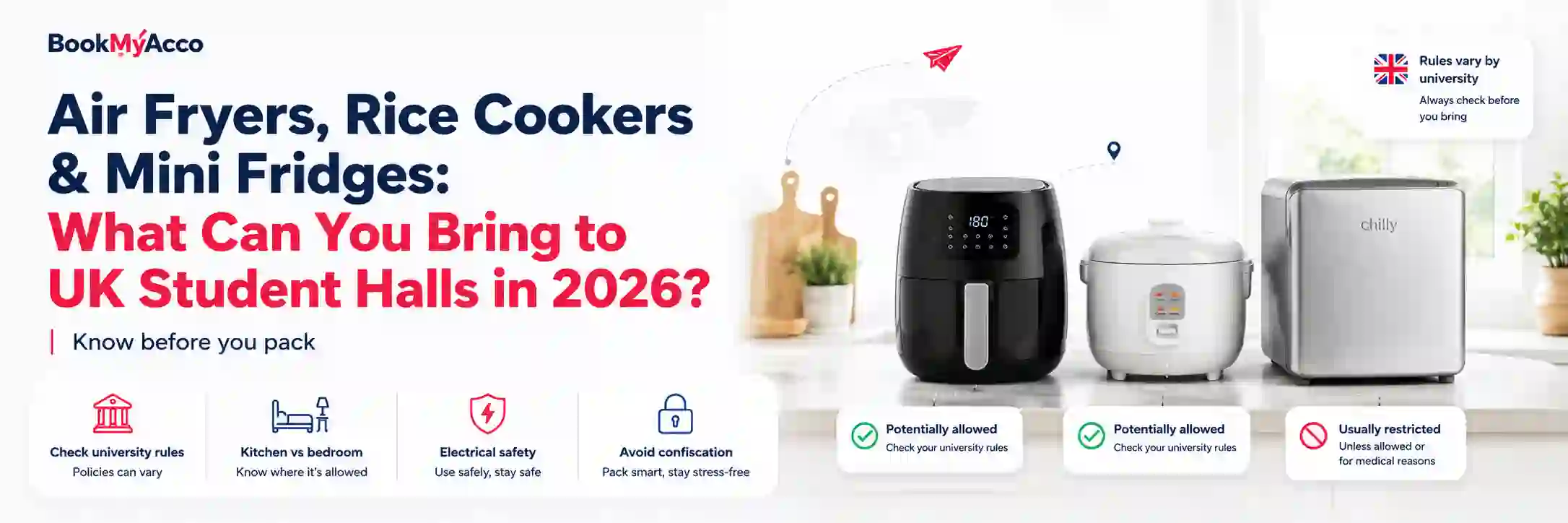
Quick answer: there is no single UK-wide list of kitchen appliances that every student hall allows. The rule normally depends on the university, residence and where the appliance will be used. Surrey currently allows air fryers and rice cookers in accommodation kitchens if they are in good working order, have a three-pin UK fused plug and meet the residence electrical-safety rules. Royal Holloway also allows air fryers and rice cookers in self-catered kitchens, but not in student bedrooms. UCL forbids the use of cooking equipment such as rice cookers, kettles, microwaves and air fryers in bedrooms and says refrigerators are not permitted in rooms unless required for disability or health reasons. Reading adds an important international-student warning: appliances must be suitable for the UK electrical supply and students should not use equipment designed for another country's supply.
That means the safest packing rule is not 'air fryers are banned' or 'rice cookers are allowed'. It is: check your exact halls handbook, separate bedroom rules from kitchen rules, and check electrical compatibility before travelling. A student can own an appliance that is perfectly legal in the UK but still breach their accommodation licence by storing or using it in the wrong place.
International students should be especially cautious with appliances brought from home. The physical plug can be changed with an adaptor, but an adaptor does not change the electrical characteristics of the appliance. If the residence says overseas appliances or adaptors are prohibited, buying a compliant appliance after arrival can be cheaper and safer than bringing one in luggage.
Why student-hall appliance rules vary so much
Halls rules are primarily about fire safety, electrical load, insurance, ventilation and the design of the building. A modern self-catered flat with a full kitchen is different from a catered hall with only a pantry. Universities therefore make different judgments about which additional appliances residents can use and where they can be stored.
Surrey's kitchens already contain core appliances such as a kettle, toaster, fridge, freezer, microwave and cooker. It still allows rice cookers and air fryers where they meet the rules. Royal Holloway allows several additional kitchen appliances only in self-catered kitchens with an oven and hob, and specifically says those items are not allowed in catered-hall pantries. UCL prohibits cooking in bedrooms and controls additional appliances under its residence regulations.
The useful question for a student is not simply 'Is this item banned?' but 'Is this item allowed in my residence, in this room, and in this location?' A university may allow an appliance in a communal kitchen while prohibiting the same appliance in a bedroom because the ventilation, fire detection and supervision are different.
Can you bring an air fryer to university halls?
Sometimes. Surrey explicitly says air fryers are permitted in university accommodation kitchens provided they meet electrical-safety requirements, are in good working order, use a three-pin UK fused plug and are not left unattended while in use. Royal Holloway also lists air fryers among the items students can bring to self-catered kitchens, while banning them from bedrooms and certain catered-hall pantry areas.
UCL takes a stricter location-based approach. Its 2026/27 regulations say cooking equipment including air fryers must not be used in a study bedroom. The equipment may only be used in designated kitchen areas under the applicable rule. A student who reads only the word 'air fryer' on a packing blog could therefore get the wrong impression if the article does not distinguish kitchen use from bedroom use.
Before buying one, also ask whether the kitchen already has enough equipment and worktop space. Bringing a bulky appliance into a six- or eight-person shared kitchen can create storage conflict even where it is technically permitted. Agree storage and cleaning expectations with flatmates rather than treating communal counters as personal space.
Are rice cookers allowed in student accommodation?
Rice cookers are another example where the answer depends on the residence. Surrey says they can be used in accommodation kitchens subject to electrical-safety rules. Royal Holloway lists rice cookers as allowed in qualifying self-catered kitchens. UCL's rules say rice cookers must not be used in study bedrooms and cooking must take place in the designated kitchen.
For international students, the electrical specification matters as much as the halls rule. Reading's halls handbook warns that the UK supply is 240V and that students should not use electrical items made for another country's electrical supply. It even uses a rice cooker from another country as an example of an item that should not be used if it is not designed for the UK system.
The practical recommendation is to bring the recipe knowledge, not necessarily the appliance. If your rice cooker is not clearly rated for the UK supply and fitted with an acceptable plug, buy one after arrival if your halls permit it. That avoids using an unsafe voltage converter or non-compliant adaptor simply because the appliance was expensive at home.
Can you keep a mini fridge in your room?
Often not. UCL's 2026/27 accommodation regulations say refrigerators are not permitted in student accommodation unless required for disability or health-related reasons, in which case the student should request permission before arrival. Reading's handbook similarly describes room fridges in the context of medical need and provides shared fridge/freezer capacity in self-catered kitchens.
The reason is not that a small fridge is inherently dangerous in every setting. The residence has to manage electrical load, heat, ventilation, cleaning, pest control and consistency across rooms. A student can therefore find private studios where a fridge is already included while a university hall prohibits adding a personal mini fridge to a standard bedroom.
If medication must be refrigerated, do not hide a fridge in the room. Contact the accommodation or disability team before arrival and ask what approved medical-fridge arrangement is available. That creates a documented exception and ensures the equipment meets the building's safety requirements.
Kettles, toasters and microwaves: usually kitchen-only
Students often assume small appliances are harmless in a bedroom because they use them at home. University halls generally treat heating and cooking devices more strictly. UCL says kettles and toasters are provided in each kitchen and residents must not use cooking equipment in study bedrooms. Surrey says all cooking appliances, including kettles, must be used only in the kitchen.
A bedroom kettle can create steam near electrical equipment, encourage food preparation away from fire-safe kitchen surfaces and make it harder for the halls team to manage cooking-related alarms. The rule is therefore usually about the location, not whether the student can make tea at all.
Before packing a kettle, toaster or microwave, check what the residence already provides. Duplicating communal appliances wastes luggage allowance and kitchen storage. For international students, it can also introduce an unnecessary electrical-safety issue when a compliant UK appliance is already installed.
Overseas electrical appliances: plug shape is not the only issue
Reading's current halls guidance is particularly useful for international students because it explains that the UK electrical supply is 240V and tells residents not to use electrical items designed for another country's supply. It also requires appropriately marked plugs and the correct rated fuse and warns against unsafe adaptors.
This matters because a travel adaptor changes the physical connection; it does not automatically convert voltage or make an appliance compliant with a residence's electrical rules. Some chargers are designed for a wide input range and are suitable internationally, while heating or motor appliances may not be. Check the manufacturer's rating label rather than assuming an adaptor solves everything.
UCL's move-in guidance also lists overseas electrical adaptors among prohibited items in its halls. That is a direct reminder that even an adaptor acceptable for travel may not be acceptable under an accommodation licence. Where the rules are strict, use compliant UK equipment purchased after arrival.
What electrical-safety checks do halls expect?
Surrey says appliances must be in good condition, working order and fitted with a three-pin UK fused plug. Royal Holloway's guidance refers to PAT testing for several personal electrical items and standard UK plugs. Reading says staff can inspect equipment where there are concerns about safety and can remove items they suspect are unsafe.
Students should not modify plugs themselves unless they are competent to do so, and should not use damaged cables, loose sockets or cheap multi-plug cubes. Extension leads can also be restricted because overloaded sockets are a common fire risk. If the hall offers a testing process, use it when there is any doubt.
A safety inspection is not an accusation that the student has done something wrong. It is a way to determine whether the device is suitable for the building. Keeping purchase information and the appliance rating label can make that check easier.
Items that are commonly prohibited
Although the exact list varies, halls frequently restrict portable heaters, open flames, candles, incense, electric drying equipment, unsafe adaptors and cooking in bedrooms. UCL's 2026/27 list includes portable heating equipment, electric clothes-drying equipment, hotplates, certain mood lighting and items with a naked flame. Reading likewise bans or restricts equipment it considers a fire or electrical risk.
The reason to check the full list is that a student can focus on obvious kitchen items and overlook a decorative or convenience item. Fairy lights, plug-in air fresheners, humidifiers or electric blankets can appear ordinary at home but be restricted in a residence because of fire-load or electrical-policy concerns.
If an item is not mentioned, that does not automatically mean it is permitted. Use the halls helpdesk or accommodation team for a written answer before bringing expensive equipment that could be removed or stored until move-out.
University examples: the same item, different rule
| Item | Surrey | Royal Holloway | UCL | Reading |
|---|---|---|---|---|
| Air fryer | Allowed in kitchen if compliant | Allowed in qualifying self-catered kitchen | Not for bedroom use; kitchen only under rules | Check residence rules and electrical suitability |
| Rice cooker | Allowed in kitchen if compliant | Allowed in qualifying self-catered kitchen | Not for bedroom use; kitchen only | Overseas/non-UK-supply example specifically warned against |
| Mini fridge | Check residence-specific rule | Check hall-specific rule | Not permitted unless health/disability need | Generally shared provision; room fridge linked to medical need |
| Overseas adaptor | Must meet safety rules | UK plug/PAT expectations | Overseas adaptors prohibited | Use compliant fused/approved equipment |
This table is a comparison, not a national rule. The student's own residence handbook and licence remain the controlling documents.
International-student packing strategy
International students have limited baggage allowance, so heavy electrical appliances are often poor items to prioritise. Before packing a rice cooker, kettle, hairdryer or kitchen device, check whether it is already provided, whether your hall permits it and whether the rating is suitable for the UK supply. If any of those answers is uncertain, buying locally can be simpler.
Pack items that are difficult to replace or personally important, then source commodity electricals in the UK. This also makes warranty, plug compliance and returns easier. Students sharing a kitchen can wait until they meet flatmates before buying optional appliances so that six people do not arrive with six air fryers.
For appliances linked to cultural cooking, it can still be worth bringing or buying one, but confirm storage and use rules first. A permitted rice cooker in a communal kitchen can be extremely useful; the same device used in a bedroom can breach the agreement.
Studios, PBSA and university halls can have different rules
A private studio with its own kitchenette may include a fridge, microwave and hob inside the unit by design, while a university bedroom in a cluster flat can prohibit the same cooking activity because the designated kitchen is elsewhere. Students should therefore compare room configuration as well as the provider's appliance list.
BookMyAcco listings can help students identify whether a room is a studio, en-suite or shared accommodation before booking. For example, Aparto Queens Court in Reading lists studios with private kitchens and also en-suite rooms with shared kitchens. The practical appliance needs are different for those two room types even within one property.
Never assume private PBSA is automatically more relaxed than university halls. Providers also have fire-safety and prohibited-item rules, and the tenancy agreement can limit additional appliances. Check the exact residence handbook after booking.
What not to buy before you know your room
Avoid buying a mini fridge, microwave, toaster, kettle or large kitchen appliance until you know what the accommodation already contains. In many halls those basics are supplied, and adding personal versions is either prohibited or unnecessary. The same principle applies to large furniture and electric drying equipment.
Students are often targeted by move-in shopping lists that encourage them to buy everything before arrival. A better method is to separate essentials for the first 48 hours from items that can wait. Bedding, medication, documents and basic kitchen utensils can be necessary immediately; an air fryer can wait until the flat has discussed whether anyone actually needs one.
Waiting can save money and reduce waste. It also prevents the student from discovering at check-in that a £100 appliance cannot be stored or used in the building.
What happens if halls find a prohibited appliance?
University regulations commonly allow staff to remove or hold unsafe or prohibited items. UCL says prohibited items found in accommodation can be removed and held until the resident moves out, and breaches can become disciplinary matters. Reading says staff can remove electrical equipment they suspect is unsafe and contact the resident about next steps.
Do not try to hide the item or repeatedly use it after being told it is not permitted. That can turn a simple packing mistake into a licence or disciplinary issue. Ask whether the item can be collected by a family member, stored elsewhere or taken home during the next trip.
If you think an appliance has been wrongly classified, use the accommodation complaints or help process and provide the product specifications. The correct route is written clarification, not arguing with reception during a safety inspection.
Before-you-pack appliance checklist
- Open your exact 2026/27 halls handbook or residence rules.
- Check whether the item is allowed in the bedroom, kitchen or nowhere.
- Check what appliances the kitchen already provides.
- Read the appliance voltage/input rating.
- Use a compliant UK fused plug where required.
- Avoid overseas adaptors where the residence prohibits them.
- Ask about PAT or safety testing if uncertain.
- For mini fridges linked to medication, request permission before arrival.
- Do not pack open-flame or portable-heating items without checking the rules.
- Wait to buy optional kitchen appliances until you have met your flatmates and seen the space.
This checklist is more useful than a generic national packing list because it forces the student to match the item to the actual building.
Common appliance mistakes in student halls
The first mistake is assuming that because an appliance is sold legally in the UK, halls must allow it. The second is checking whether an air fryer or rice cooker is allowed but failing to notice that the permission applies only to the communal kitchen. The third is bringing an overseas appliance with a travel adaptor without checking the voltage and residence rules.
Students also buy equipment already supplied by the residence, use bedroom sockets for cooking, overload extension leads or leave high-heat appliances unattended. These mistakes can trigger alarms, damage sockets or result in the appliance being removed.
Finally, do not use a medical need as an informal workaround. If you genuinely need a room fridge for medication or another adaptation, request the approved arrangement before arrival so that the accommodation team can support you properly.
Final recommendation
The answer to 'Can I bring an air fryer, rice cooker or mini fridge to student halls?' is residence-specific. Surrey and Royal Holloway show that air fryers and rice cookers can be allowed in suitable kitchens, while UCL demonstrates strict bedroom controls and a general ban on personal refrigerators except for approved health needs. Reading adds the crucial international-student rule that electrical equipment must be suitable for the UK supply.
Before packing, check the exact 2026/27 halls rules, not a generic social-media list. Pay attention to where the appliance can be used, what electrical standard it must meet and whether the building already supplies the same item.
If you are travelling internationally, buying optional appliances after arrival is often the safest decision. You will know your room, the kitchen, the rules and your flatmates before spending money or luggage allowance on equipment you may not be allowed to use.