
Student accommodation damage charges: the quick answer
Quick answer: yes, you should photograph your student room on move-in day and complete the official inventory or room-condition report within the residence's deadline. UCL's 2026/27 rules say residents should review their room condition report within seven days of moving in and that the completed report can be used at the end of the licence period to determine damage charges. Queen Mary likewise gives students seven days from arrival to submit an online inventory and warns that if the form is not returned, the University will assume the room and furnishings were in good condition with no damaged or missing items. Reading makes the financial risk even clearer: damage above fair wear and tear can be charged to the resident, and unidentified communal damage can sometimes be divided among residents who had access to the area.
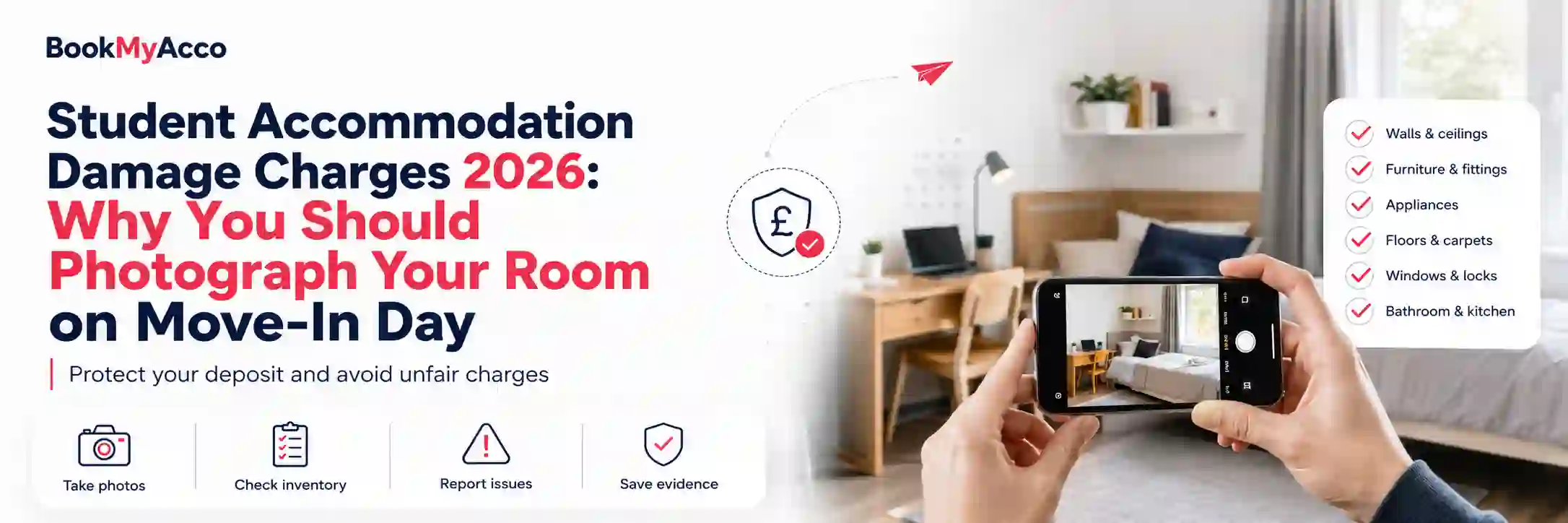
Photographs are not a replacement for the official inventory, but they are useful supporting evidence. Take wide photos of the room and close-ups of existing marks, stains, chips, scratches, broken fittings and furniture condition before unpacking heavily. Photograph the mattress, desk, chair, wardrobe, walls, floor, bathroom and any shared kitchen area you are asked to inspect. Keep the original timestamped files and submit the university's formal report on time.
The goal is not to prepare for an argument with the landlord. It is to create an accurate shared record of the room's starting condition so genuine pre-existing damage is not confused with damage caused during your stay.
Why move-in day evidence matters nine months later
Most students are focused on keys, parents, luggage and meeting flatmates when they first enter a room. A small scratch on a desk or stain on a mattress looks unimportant. At move-out, however, the accommodation team has to compare the room against the starting condition and decide whether repair or cleaning costs are attributable to the resident. If the official record says the room began in good condition and the student never corrected it, proving that an old mark existed can become much harder.
UCL explicitly says the room condition report is used at the end of the licence period to determine damages and charges. Queen Mary's inventory process makes the same logic clear: failure to return the form means the University assumes no items were damaged or missing when the student arrived. The first week is therefore a short evidence window with consequences that may not appear until the end of the academic year.
A five-minute photo sweep and a careful inventory can protect hundreds of pounds of potential dispute. It can also help the halls team fix problems early rather than allowing a leak, loose fitting or broken item to become worse.
Inventory report vs photos: you need both
The official inventory or condition report is the primary record because it is built into the accommodation provider's process. UCL asks students to review the condition report through the Accommodation Portal. Queen Mary sends an online inventory link as part of residential check-in. Reading makes its inventory available through the Home at Halls app after keys are collected.
Photographs add detail that a dropdown or short text field cannot always capture. Instead of writing 'desk scratched', photograph the exact scratch, its size and its location. If the mattress has a faint mark, take a well-lit close-up and a wider photo showing which side of the mattress it is on. If a wardrobe door does not close properly, photograph or video the alignment and report the maintenance problem separately.
Do not rely only on private photos and skip the provider's inventory deadline. A folder on your phone is useful evidence, but the formal submission is what tells the accommodation team about the issue while it can still be inspected.
UCL: review the room condition report within seven days
UCL's 2026/27 accommodation regulations say the Hall Team completes a room inspection before arrival and residents should review the room condition report within seven days of moving into the room. The student logs into the Accommodation Portal, selects Room Condition and follows the instructions to review the report.
The University says this completed report will be used at the end of the licence period to determine any damages and charges attributable to the resident. UCL also states that residents are not required to pay for disrepair caused by fair wear and tear. That makes the report a two-way protection: UCL has a documented starting condition and the student has a route to correct anything the pre-arrival inspection missed.
If a problem is discovered after the seven-day review window, report it immediately anyway. A late maintenance report is still better than allowing damage to worsen, but the strongest evidence for a pre-existing issue is a timely move-in record.
Queen Mary: no inventory can mean “good condition” is assumed
Queen Mary Residential Life says students receive an online inventory link and have seven days from their arrival date to complete and submit it. The inventory is where the resident records the condition of the room and furnishings on arrival. Queen Mary warns that if it does not receive the completed form by the deadline, it will assume everything in the room was in good condition and that there were no damaged or missing items.
That wording is especially important for students who think they can simply mention a problem at move-out. If a chair was already chipped but the inventory was left blank, the student has weakened their position. The provider can still investigate fairly, but the cleanest record would have existed if the damage had been reported on day one.
Use specific descriptions. 'Wall damaged' is less useful than 'two paint chips approximately 2cm wide above the desk on the left wall'. Clear detail helps staff inspect the correct location and reduces ambiguity later.
Reading: inventory appears after check-in
Reading's halls handbook says that once the student has checked in and received keys, the inventory appears through the Home at Halls app. Residents can record issues in the room and complete the inventory from the app or its web version. That makes the inventory part of the move-in workflow rather than an end-of-year form.
Reading also tells residents to report faults and maintenance issues as soon as they occur so problems can be fixed before they become worse or cause further damage. This distinction is useful: the inventory records what was already present; the maintenance system records a problem that needs action. Some issues belong in both places. A damaged window latch, for example, should be recorded as part of the starting condition and reported for repair.
Students should not try to repair university property themselves. A well-intentioned DIY fix can create extra damage or make it harder to establish what caused the original problem.
What exactly should you photograph?
Start with a wide photo from each corner so the overall condition and furniture layout are visible. Then take focused images of the walls, floor or carpet, skirting boards, desk, chair, bed frame, mattress, wardrobe doors, shelves, curtains or blinds, window, radiator, sockets and light fittings. If the room has an en-suite, include the shower, toilet, sink, mirror, seals and any existing limescale, cracks or stains.
In a shared kitchen, photograph areas the provider asks residents to review: worktops, cabinet fronts, oven and hob, fridge shelves, freezer drawers, table, chairs and obvious existing marks. The aim is not to create hundreds of random images. Each photo should be clear enough that someone unfamiliar with the room can understand what condition it records.
Use good lighting, avoid filters and keep the original files. If the phone automatically stores the date and time, preserve that metadata. A short video walkthrough can be useful as a secondary record, but photographs are easier to reference in a later email or appeal.
Damage vs fair wear and tear
Universities distinguish damage from normal deterioration caused by reasonable use. UCL says residents are not responsible for fair wear and tear. Reading defines damage as deterioration above fair wear and tear. The difference depends on the item, age, expected lifespan and nature of the mark.
A carpet becoming slightly worn along a normal walking route after an academic year is different from a large burn mark. Light ageing of a desk surface is different from deep carving. Small signs of ordinary use can be expected; avoidable breakage, staining or misuse can lead to repair or replacement charges.
Students should not assume that every mark is automatically chargeable, but they should also not rely on the phrase 'wear and tear' to excuse clear damage. If a charge is disputed, ask for the evidence, the reason the provider considers the damage beyond normal use and the basis of the repair or replacement cost.
You can be charged for communal damage you did not personally cause
Shared-area rules can surprise students. UCL says that where damage to communal areas cannot be attributed to an individual after reasonable investigation, the reasonable repair or replacement cost can be divided equally among students permitted to use that area. Reading similarly says that unidentified damage in communal areas can be charged equally among residents with access to the affected area.
Reading adds an unusual practical detail: if a student had recorded themselves as away from halls at the relevant time through its app, they can be excluded from certain communal damage charges. This shows why residence administration matters even when the student did nothing wrong.
The best prevention is collective. Report damage promptly, do not ignore vandalism in shared kitchens and tell the hall team when something has been broken. A silent flat can end up sharing a bill that could have been attributed accurately if the incident had been reported.
Reading: damage can come out of the deposit
Reading says damage charges will normally be deducted from the student's £250 damage deposit. Where an individual item of damage costs more than £100, the resident may be asked to pay the charge within 14 days. The University also explains that charges can include costs associated with disposal, delivery and out-of-hours callouts, not just the price of the physical replacement.
Cleaning can also create charges. Reading says additional cleaning may incur a minimum fee and publishes separate current damage-charge information. The important principle is that a room can be physically undamaged yet still create a bill if it is left in an unacceptable condition.
Students should therefore treat move-out cleaning and key return as part of financial planning. The room does not need to look brand new, but it should be returned in the condition required by the agreement, allowing for fair wear and tear.
UCL: reasonable repair and cleaning costs can be invoiced
UCL's regulations say it can invoice residents for reasonable repair, replacement or cleaning costs and gives a payment period for those invoices. Where communal cleaning is required and responsibility cannot be identified, the contractor cost can be divided among residents permitted to use the area. The University says no additional charge is added on top of the contractor cleaning cost in that scenario.
This is another reason to distinguish a damage charge from a disciplinary fine. A repair or cleaning charge is intended to recover a cost connected to the property. A disciplinary sanction can be a separate consequence for behaviour. Reading's handbook explicitly explains that fines and damage charges are different mechanisms.
When reviewing a bill, ask what the charge represents: repair, replacement, cleaning, key loss, callout, or disciplinary action. Understanding the category makes it easier to challenge an error through the right process.
Decorating your room without creating damage charges
Wall decorations are a common source of avoidable charges. Reading warns against sticky tape, sticky hooks, Blu Tack, drawing pins and nails where they can mark walls and tells residents to use the provided pin boards. Queen Margaret University's accommodation A-Z similarly says residents should not use tack, adhesive tape, nails or picture hooks on walls and furniture and that attributable damage can be recharged.
Before hanging posters or lights, check the halls rules. Some residences allow only a noticeboard; others approve specific removable products. A product marketed as 'damage free' is not necessarily damage free on the hall's paint finish, and the accommodation agreement controls what is permitted.
If you find an existing wall mark at move-in, photograph it before placing anything nearby. Otherwise, the final inspection may not be able to distinguish the original mark from damage associated with your decorations.
Mattress, bathroom and cleaning evidence
Mattresses and bathrooms deserve special attention because staining, mould, seal damage and cleanliness can generate disputes. Reading specifically mentions mattress staining as an example of damage that can result in charges and recommends using the mattress protector provided. Photograph both the general mattress condition and any existing marks before bedding covers it.
In an en-suite, document existing mould spots, cracked sealant, limescale, damaged fittings or slow drainage and report maintenance problems promptly. A student should not be charged for a pre-existing maintenance issue, but failing to report a leak can allow it to cause secondary damage that becomes harder to separate from resident responsibility.
At move-out, clean according to the provider's checklist rather than assuming normal household standards are enough. Empty the fridge, remove waste, clean the bathroom and leave supplied furniture in the required location.
Does the same advice apply to private PBSA?
Yes, even though the exact process may be called a check-in report, inventory, schedule of condition or room inspection rather than a university condition report. Private PBSA providers also need a starting record to decide whether end-of-tenancy damage is attributable to the resident. Read the tenancy and move-in email to find the deadline for corrections.
BookMyAcco students comparing student accommodation in London or other cities should ask the provider how inventory disputes are handled before move-in. A professionally managed building should have a clear route for reporting faults and room-condition issues.
The practical habit is universal: inspect first, photograph before unpacking, submit the formal inventory, report repairs separately and keep the evidence until the deposit or final account is settled.
What to do if you receive a damage charge you disagree with
Do not ignore the invoice. Read the provider's explanation, compare it with your move-in inventory and original photos, and identify whether the charge relates to your room or a shared space. Reading says residents have a right of appeal if they disagree with a charge and encourages prompt action following notification.
Prepare a concise evidence pack: the original condition report, timestamped images, maintenance tickets, emails with hall staff and any move-out photos. If the item was reported as damaged during the first week, reference the exact report date and wording. If the charge is communal and you were not present, provide any evidence the residence system recognises for absence.
Keep the tone factual. The strongest challenge is not 'I would never do that'; it is 'this mark appears in my move-in photo dated X and was listed in the condition report submitted on Y'.
Move-in evidence checklist
- Do the inspection before fully unpacking.
- Take wide room photos from multiple corners.
- Photograph every existing scratch, stain, chip or broken fitting.
- Photograph the mattress before adding bedding.
- Check desk, chair, wardrobe, windows, curtains, lights and sockets.
- Inspect the en-suite or shared bathroom areas you are responsible for.
- Complete the official inventory/condition report within the deadline.
- Report maintenance faults separately and save ticket numbers.
- Keep all original photos and confirmation emails until after move-out.
- If the flat has communal damage, report it rather than assuming someone else will.
This process takes less time than resolving a disputed charge months later and creates a fair record for both the student and the accommodation team.
Common mistakes that lead to avoidable damage disputes
The first mistake is taking photos but never submitting the official inventory. The second is completing the inventory quickly and writing 'all fine' without checking the mattress, underside of furniture or bathroom. The third is discovering a maintenance fault and trying to fix it personally rather than reporting it.
Students also delete photos to save phone storage, lose access to an old cloud account, or take only close-ups with no wider image showing where the damage is located. At move-out, some residents assume the cleaning team will dispose of rubbish or personal items without charge.
Finally, do not assume flatmates will report communal damage. If you notice something significant, tell the halls team. A clear early report can protect the whole flat from shared costs and ensure the item is repaired before it becomes a safety issue.
Final recommendation
Photographing your student room on move-in day is one of the simplest financial-protection steps you can take. UCL and Queen Mary both give residents a seven-day window around the condition/inventory process, while Reading shows how damage, cleaning and communal-area costs can later affect deposits or create additional invoices.
Use photographs as supporting evidence, not as a substitute for the formal inventory. Record the starting condition clearly, submit corrections on time and report faults through the official maintenance system. Keep those records until the final accommodation account is settled after move-out.
The objective is fairness rather than confrontation. A detailed day-one record protects students from paying for pre-existing damage and protects accommodation providers when new damage genuinely occurs during the tenancy.