
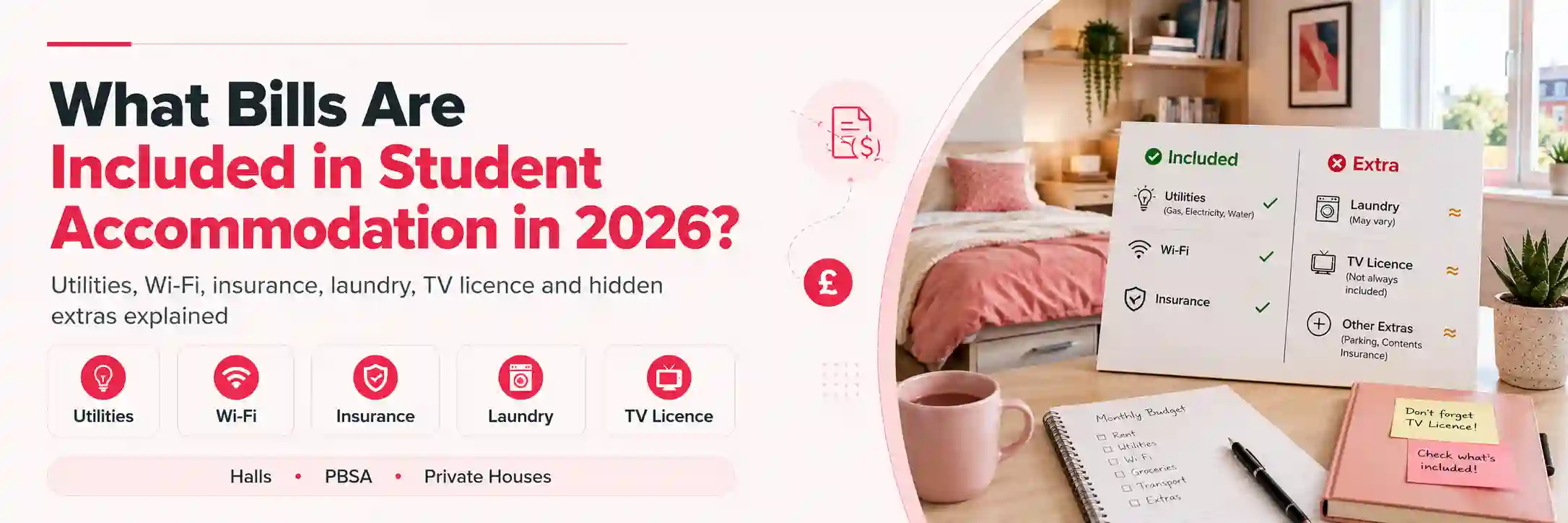
“All bills included” in student accommodation: the quick answer
Quick answer: “all bills included” usually covers core utilities such as electricity, gas/heating and water, and often Wi-Fi, but it does not always cover every housing-related expense. Aston’s 2026 undergraduate accommodation says all bills are included excluding TV Licence, alongside Wi-Fi and basic contents insurance. St Mary’s says Wi-Fi, electricity, water and heating are included in several halls, while TV Licence and laundry costs are excluded in its published hall information. Goldsmiths’ Raymont Hall includes utility bills, Wi-Fi and basic possessions insurance but excludes TV Licence and the cost of using the on-site launderette. Surrey includes gas, electricity, water, broadband, basic insurance, communal-area cleaning, maintenance and 24/7 security in University accommodation fees.
So “all inclusive” should be read as a contract-defined bundle, not a promise that the student will never spend money connected with the building. Laundry, TV licensing, bedding, food, parking, gym memberships and damage charges can still sit outside rent.
The best booking comparison is therefore a checklist of included and excluded costs. Two rooms at the same weekly rent can have very different real annual costs.
Why “all bills included” is confusing
Student accommodation providers use “bills included”, “all bills included” and “utilities included” as marketing shorthand. Those phrases are useful, but the legal and financial meaning comes from the tenancy/licence and the property-specific list of inclusions.
A university may call electricity, water, heating and internet the bills, while treating laundry as a pay-per-use service. Another property may bundle a bus pass or basic contents insurance. A catered hall may include meals during term but exclude them over Christmas and Easter. The phrase alone is therefore too broad to compare properties accurately.
Students should convert the marketing phrase into line items. If a cost is not listed as included, assume you may need to budget for it until the provider confirms otherwise.
Electricity, gas/heating and water: usually the core bundle
Core utilities are the most consistent inclusion in university halls and PBSA. Aston says all bills are included in its campus accommodation, excluding the TV Licence. St Mary’s lists Wi-Fi, electricity, water and heating as included. Goldsmiths’ Raymont Hall lists electricity, water and gas among the included utility bills. Surrey includes gas, electricity and water.
Private shared houses are more variable. Some landlords offer “bills included” tenancies, while others require tenants to set up energy and broadband accounts themselves. Where bills are bundled, check whether the contract has a fair-usage or energy cap; “included” can still have a usage condition in private arrangements.
For BookMyAcco comparisons, the most useful field is not simply bills_included=true. It is a structured list of electricity, gas/heating, water and any cap or fair-usage note.
Wi-Fi and broadband: commonly included, but check the service
University halls normally include internet access, and the searched examples all highlight Wi-Fi or broadband. Aston includes Wi-Fi throughout the property. St Mary’s lists superfast Wi-Fi. Goldsmiths includes Wi-Fi. Surrey includes a broadband connection to its ResNet service.
The practical difference is service quality and device rules. A student gamer, streamer or design student uploading large files should check whether wired Ethernet is available, whether personal routers are allowed and how support works when the network fails.
If a private property does not include broadband, add installation, monthly service and contract length to the annual cost. A cheap room with no internet can easily lose part of its price advantage.
TV Licence: often excluded even when “all bills” are included
TV Licence is one of the most common exceptions. Aston explicitly says all bills are included except TV Licence. St Mary’s hall pages list TV Licence as the individual student’s responsibility. Goldsmiths’ Raymont Hall also excludes the TV Licence.
Whether a student personally needs a licence depends on how they watch television and live broadcasts, so the accommodation provider cannot simply treat it like electricity. Students should use the official TV Licensing guidance for their own viewing habits rather than assuming the presence of a communal TV covers private devices.
The budgeting lesson is straightforward: “all bills included” does not prove TV Licence is included. Look for an explicit line in the contract or hall guide.
Laundry: facilities included does not mean washes are free
Accommodation pages often say “laundry facilities” are included, but that wording can mean only that machines exist in the building. St Mary’s says several halls have on-site laundry facilities but specifically lists laundry costs as excluded. Goldsmiths similarly includes access to the launderette but excludes the cost of using it.
A student doing two washes and one dryer cycle each week can spend a noticeable amount across a 40- or 50-week tenancy. The exact machine prices vary, so do not hard-code a national laundry estimate into a property comparison.
BookMyAcco can improve clarity by distinguishing laundry_facility=true from laundry_included_in_rent=true. Those are very different promises.
Basic contents insurance: often bundled, but cover is limited
Aston includes basic contents insurance. St Mary’s says insurance is included in rent. Goldsmiths includes basic possessions insurance, and Surrey includes a belongings-insurance premium in its accommodation fee. This can save the student from buying a separate basic policy.
However, “basic” matters. Expensive laptops, bicycles, phones, musical instruments or accidental-damage scenarios may have limits, exclusions or registration requirements. Students should read the insurance summary rather than assuming every possession is fully protected.
If a student already has cover through a family policy or bank product, check for duplication. If high-value equipment is essential for the course, consider whether extra cover is needed.
Cleaning, maintenance and security can also be part of the rent bundle
Some accommodation fees include services students do not immediately think of as “bills”. Surrey includes cleaning of communal areas, maintenance repairs, 24/7 security and welfare/support services. University and PBSA rents can therefore bundle operational services that a private shared-house tenant handles differently.
That does not mean the provider cleans the student’s bedroom or washing up. The contract should say which communal areas are cleaned and what remains the resident’s responsibility. Damage caused by residents can still be charged separately even where maintenance is included.
When comparing a private house with halls, give a value to maintenance response and security if those services matter to the student, but do not count ordinary damage charges as “included”.
Council Tax: usually not a normal student cost, but household status matters
GOV.UK says households where everyone is a full-time student do not have to pay Council Tax, and qualifying student halls are exempt. In a mixed household, students are generally disregarded but the non-student occupants can still create a Council Tax bill and the exact liability depends on the household/tenancy structure.
This is why a property advert saying “Council Tax included” should be treated carefully for full-time students: in a student-only household there may be no Council Tax charge to include in the first place. For mixed households, couples or students whose course status changes, ask the local council for the specific treatment.
A student should not pay a private “Council Tax contribution” without understanding why the property is liable and who is legally responsible.
Catered halls: meals can be included, but not always every day of the year
Catered accommodation adds another layer to the meaning of “included”. St Mary’s publishes meal plans in catered halls, but its current pages say meals are not provided during Christmas and Easter breaks under the accommodation agreement. A student staying in the hall during those periods still needs a food plan.
Other universities use meal credits, fixed meal windows or term-time-only catering. The headline rent may therefore include significant food value, but only within the defined service period.
When comparing catered halls with self-catered PBSA, estimate the value of the included meals realistically and check whether unused credits expire.
Parking, transport and gym access: useful extras, not universal inclusions
Some halls bundle services beyond utilities, while others charge separately. Parking is a common extra because campus space is limited. Gym membership may be included in a specific promotion but not in every room. Some universities bundle or subsidise bus travel between campuses.
These benefits can change the total value for a student who would otherwise buy them, but they should not inflate the comparison for someone who would never use them. A free bus pass is valuable only if the residence and course actually use that route.
Create a “would I buy this anyway?” column when comparing extras. It prevents a property with many low-value perks from appearing better than a simpler room with a lower contract total.
Halls vs PBSA vs private house: typical inclusion patterns
| Cost/service | University halls | PBSA | Private shared house |
|---|---|---|---|
| Electricity/gas/water | Usually included | Usually included | Often separate unless bills-inclusive |
| Wi-Fi | Usually included | Usually included | Contract dependent |
| Basic contents insurance | Often included | Often included | Usually arrange/check separately |
| Laundry | Facilities common; usage often extra | Facilities common; usage often extra | Washing machine may be in property |
| TV Licence | Often excluded | Often excluded/contract dependent | Tenant responsibility where required |
| Council Tax | Student halls exempt | Student-status rules apply | Household-status rules apply |
| Communal-area cleaning | Sometimes included | Often included for common building areas | Usually tenant responsibility inside house |
This is a pattern, not a substitute for the specific contract. The exact property can differ.
How “extras” change the real annual cost
Suppose two rooms both cost £190 per week for 44 weeks. Room A includes utilities, Wi-Fi and basic insurance but charges for laundry. Room B costs the same rent but requires separate broadband and energy. The advertised price is identical, but Room B can be hundreds of pounds more expensive over the year.
Now reverse it: a PBSA room at £205 per week may include bills, while a £185 private room requires utilities and broadband. The cheaper headline rent is not automatically the cheaper annual contract. Add only the costs the student will genuinely pay and use conservative estimates for variable energy.
This is why an accommodation comparison tool should show total rent plus known recurring extras instead of sorting only by weekly rent.
Before-you-book “all bills included” checklist
- Electricity included?
- Gas or heating included?
- Water included?
- Any energy/fair-usage cap?
- Wi-Fi/broadband included?
- Basic contents insurance included?
- Laundry use free or pay-per-cycle?
- TV Licence included or student responsibility?
- Council Tax status clear for the household?
- Communal cleaning included?
- Parking included or charged separately?
- Bus pass or transport included?
- Gym membership included permanently or promotional?
- Meals included, and during which weeks?
How BookMyAcco should display bills more clearly
A single “Bills Included” badge is useful for scanning, but it should open into a structured breakdown. Students should be able to see Utilities, Wi-Fi, Insurance, Laundry, TV Licence, Council Tax note, Cleaning and Transport at a glance.
This also reduces sales friction. A student asking “is everything included?” can be answered from the property data rather than a generic agent response. If the provider has a usage cap, the cap should appear next to utilities rather than being hidden in the tenancy document.
For SEO, the same structured data can support property-level FAQ content such as “Does this rent include electricity?” without inventing answers.
Common mistakes with “all-inclusive” student rent
The most common mistake is treating access as free usage: a launderette can be on-site while each wash is chargeable. Another is assuming TV Licence is included because electricity and Wi-Fi are included. The university examples show that TV Licence is frequently excluded.
Students also forget that basic insurance may have limits, and that council tax depends on student/household status rather than simply the landlord’s marketing.
Finally, do not compare a catered hall and a self-catered room without accounting for the meal plan. “Bills included” is only one component of the real living cost.
Final recommendation
When a 2026 student accommodation listing says “all bills included”, read it as a prompt to open the details, not the end of the comparison. Core utilities and Wi-Fi are commonly bundled, but laundry, TV Licence and other services can remain outside the rent.
Use the provider’s written inclusions for the exact property and calculate the annual total after known extras. Aston, St Mary’s, Goldsmiths and Surrey all demonstrate slightly different bundles.
For BookMyAcco, the strongest user experience is a clear included/excluded checklist beside the weekly rent so students can compare real cost before enquiring or booking.
Students should also check whether utilities remain included during vacation periods. A 50- or 51-week contract may cover summer occupation, while a shorter university licence can end before the summer. If the student stays beyond the normal contract under an extension, the extension price can have different inclusions.
Damage, lost keys, lockouts and excessive cleaning are not normal “bills”, but they can create extra accommodation charges. An all-inclusive rent does not protect a resident from contractual charges caused by damage or breaches of residence rules. Read the schedule of charges where the provider publishes one.
For couples or dual-occupancy studios, confirm whether the advertised rent and utilities cover both occupants and whether any supplement applies. A property that is all-inclusive for one resident can still have a dual-occupancy fee or different usage terms.
Students should also check whether the included-utility promise changes during vacation or extended-stay periods. A 36- or 40-week university licence can end before summer, while a 50- or 51-week PBSA contract may include utilities for the whole tenancy. If the provider offers an extension after the normal contract, the extension can use a different weekly rate or package, so do not assume the original inclusions continue automatically.
Damage charges, lost keys, lockouts and excessive cleaning are another category that students sometimes mistake for “hidden bills”. These are usually contractual charges rather than normal utilities. An all-inclusive rent does not mean the resident can damage furniture or lose access cards without charge. Read the provider’s schedule of charges so the difference between recurring bills and avoidable penalties is clear.
For studios with dual occupancy, confirm whether the quoted rent and included utilities apply to both residents. Some providers allow couples at the same room rent, while others add a dual-occupancy supplement or use different energy assumptions. A listing can truthfully say bills included and still have a separate second-occupant charge.
Food is another major comparison item. Catered halls can look expensive because part of the rent funds meals, while self-catered accommodation shifts that cost into the student’s grocery budget. When a catered property says meals included, check the number of meals, service days, holiday closures and whether unused meal credits expire. The annual value depends on how much of the plan the student will actually use.
Transport can also be an included benefit that changes real cost. A university residence may include or subsidise a campus bus pass, while a private room farther away requires separate travel spending. Conversely, a private PBSA next to the university may eliminate transport entirely. Add the commute to the annual comparison rather than treating it as unrelated to accommodation.
For private houses with bills packages, ask who actually provides the utilities and what happens when usage exceeds any allowance. Some bills-inclusive arrangements are managed by a third-party utility company rather than the landlord. The tenancy should explain any fair-usage threshold, recharge method and responsibility when one housemate leaves. Without that detail, “included” can be less predictable than it appears.
Students moving into mixed households should pay special attention to Council Tax. A house occupied entirely by qualifying full-time students is normally exempt, but adding a non-student can change the bill. International students living with spouses or dependants can also have specific treatment. The local council, not the accommodation advert, determines liability, so check before agreeing to contribute to a bill.
For BookMyAcco, an ideal data model would store each inclusion separately: electricity, gas/heating, water, Wi-Fi, contents insurance, laundry access, laundry cost included, TV Licence, cleaning, transport and any fair-usage cap. That structure improves search filters, sales accuracy and SEO because every property can answer “what is included?” from verified data instead of one generic badge.
A final buying rule is to compare the annual net cost rather than the number of green ticks. A room with fewer bundled extras can still be better value if its base rent is much lower. Included services matter only when the student would otherwise pay for them, so put a realistic pound value beside the extras that actually affect the student’s budget.
Students should keep a copy of the inclusion list that applied when they booked. If a sales page later changes, the tenancy or licence and the written booking confirmation are the best reference points for what the provider actually promised. Saving that evidence also makes it easier to resolve disputes about utility caps, internet, cleaning or other advertised services after move-in.