
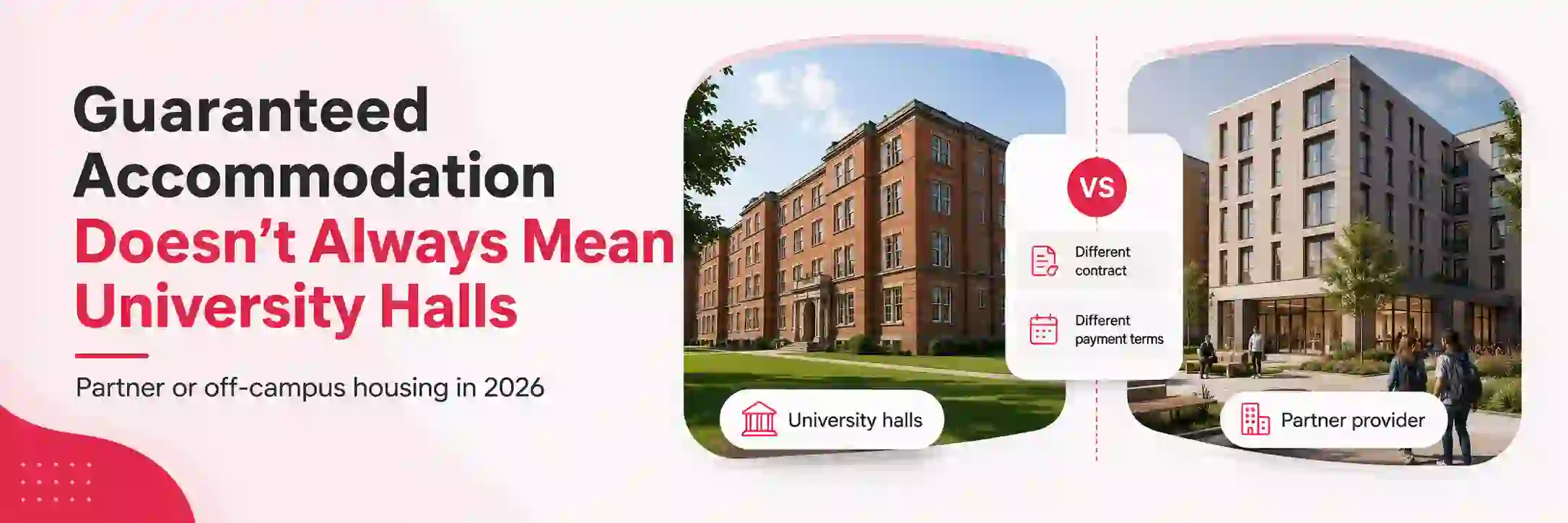
Does guaranteed accommodation always mean a university-owned hall?
Quick answer: no. A university accommodation guarantee can be fulfilled with a university-owned hall, a university-managed residence, a nominated private PBSA partner or approved off-campus accommodation, depending on the institution. Cardiff says eligible 2026 Clearing students may be allocated either a University residence or one of its private partners. Cardiff Metropolitan says its guarantee can result in Cardiff Met residences or trusted accommodation partners. Queen Mary guarantees eligible single Clearing applicants accommodation either in Queen Mary accommodation or with a partner provider. York's 2026/27 guarantee includes University-owned and managed on-campus accommodation or approved off-campus accommodation. Liverpool's first-year guarantee includes University and partner-provider accommodation.
The difference is not just branding. A partner room can change who your contract is with, who receives your rent, which advance payment is required, what cancellation rules apply, who handles maintenance, and whether the university's normal transfer procedure applies. York's Student Castle arrangement is a useful example: students apply through York and remain part of the Vanbrugh College community, but the accommodation contract and rent payments are directly with Student Castle York.
Before accepting a guaranteed room, read the exact offer rather than assuming every university-arranged room follows university-hall terms. Identify the contractual provider, complete annual cost, tenancy dates, payment schedule, cancellation route, maintenance contact, travel time to campus and any university support that continues alongside the private provider.
What an accommodation guarantee actually guarantees
An accommodation guarantee is usually an eligibility promise: if the student meets the published conditions, the institution promises an eligible accommodation offer. It is not necessarily a promise of a particular building, ensuite, studio, price, campus location or landlord. This distinction becomes particularly important after Results Day because students may have applied months earlier with a mental picture of one hall, while the guarantee is written much more broadly.
Cardiff Metropolitan is unusually explicit. Its 2026 Clearing accommodation page says eligible students are guaranteed an accommodation offer but not a particular residence, room type, location or price point. Its allocation guidance says a student may be offered a room in Cardiff Met halls or with one of its trusted accommodation partners if preferred stock is unavailable.
Read the guarantee first to confirm you are protected from having no university-arranged option, then read the final offer separately to decide whether the actual room is affordable and suitable. Guarantee eligibility and room suitability are two different decisions.
Four accommodation models that can sit behind the word “guaranteed”
Students often use 'university accommodation' as one category, but the operational models can be different. The contract is the clearest way to understand which model you have.
| Model | How it typically works | What to verify |
|---|---|---|
| University-owned and managed hall | University owns and operates the residence | University licence/contract, rent dates, cancellation and transfer terms |
| University-managed or approved residence | University manages or formally approves accommodation it may not fully own | Who contracts with you and who manages day-to-day operations |
| Partner or nominated PBSA | Private operator supplies rooms through a university partnership or nomination agreement | Private provider tenancy/licence, advance payment and cancellation policy |
| Approved off-campus accommodation | University guarantee includes approved external housing | Exact provider/landlord, location, contract and support route |
The labels partner, nominated, approved and university-arranged do not by themselves tell you the legal position. Two universities can use similar language while operating different contracts. Always follow the room offer to the named contracting party.
Cardiff: the Clearing guarantee can include private partners
Cardiff University's 2026 Clearing accommodation page says most eligible Clearing students are guaranteed accommodation and can be allocated either a room in University residences or one of its private partners. That wording means the guarantee is broader than a promise of a Cardiff-owned building.
If Cardiff sends a private-partner offer, check whose terms you are being asked to accept and which organisation will collect the rent. Also check whether the university's five-day offer acceptance window and any partner-specific payment requirement interact. Do not assume the university residence handbook automatically governs a private-provider contract.
Students who want to understand the wider private market can compare student accommodation in Cardiff. BookMyAcco listings are independent market comparisons unless Cardiff University itself identifies a particular allocation as part of its partner scheme.
Cardiff Met: the guarantee expressly includes trusted accommodation partners
Cardiff Metropolitan University says eligible Clearing students applying by its published 17 August 2026 deadline are guaranteed an accommodation offer, but that offer can be in Cardiff Met residences or with trusted accommodation partners. The University also says it cannot guarantee a specific residence, room type, location or price point.
Cardiff Met's allocation guidance explains the contractual consequence clearly: where a partner room is offered, the offer comes directly from the partner and the contract is with the provider rather than Cardiff Met. This is exactly the kind of detail students need before paying because the deposit, instalments, guarantor requirements, cancellation procedure and complaints route can therefore be provider-specific.
Cardiff Met's accommodation information also shows why universities rely on partners at scale: alongside its own halls, it allocates significant private en-suite stock through nomination relationships. Partner accommodation is therefore not simply an emergency overflow model; it can be part of the planned annual housing system.
Queen Mary: Clearing accommodation can be Queen Mary or a partner provider
Queen Mary University of London says eligible single applicants joining through Clearing for September 2026 are guaranteed accommodation either in Queen Mary accommodation or with a partner provider. For a Results Week applicant, that is valuable protection—but it still leaves a second question: what exactly are the terms of the room that is offered?
If a partner room arrives, look for the provider name, tenancy dates, total rent, advance payment or deposit, instalment options and cancellation terms before accepting. A partner's agreement may not use the same language or cooling-off route as Queen Mary's own halls.
Students considering independent alternatives around Queen Mary can compare verified BookMyAcco pages such as Aldgate Residence and Sunlight Apartments. These should not be described as Queen Mary partner allocations unless the University explicitly confirms that relationship.
York: guaranteed accommodation can be approved off-campus housing
The University of York's 2026/27 accommodation guarantee says eligible students can receive an offer of University-owned and managed on-campus accommodation or approved off-campus accommodation. Its Clearing guarantee uses the same broad principle: the protection is about receiving an eligible room, not necessarily living in a University-owned block.
York also asks applicants for consent to share relevant accommodation and contact details with third-party providers when needed to arrange an offer. That is a practical clue that the guarantee can involve organisations outside the University's own residence portfolio.
Students should therefore check the exact property and provider before assuming the room will follow standard on-campus terms. Off-campus does not automatically mean worse, but transport, contract management and payment may differ.
York Student Castle: university community with a private-provider contract
York's Student Castle arrangement demonstrates the partner model in concrete terms. New undergraduates can apply through the York accommodation portal for the 2026/27 Student Castle allocation. Residents remain part of Vanbrugh College and can access college events and community support even though the building is off campus.
The legal and payment relationship is different from a University-owned hall. York states that the accommodation contract is with Student Castle York and rent is paid directly to the provider. The published 2026/27 room details also require a £250 advance payment to secure the room.
This is why the phrase 'university accommodation' is sometimes too imprecise for financial decisions. A room can be allocated through the university, connected to university student life and still create a direct private-provider contract.
Liverpool: a partner-provider room means a provider tenancy
The University of Liverpool says its first-year accommodation guarantee includes University and partner-provider accommodation. It adds an important warning for students: if the offer comes from its preferred provider, the tenancy agreement is with that provider rather than the University.
Liverpool advises students to read the terms and conditions before accepting any offer. Its own University accommodation licence has a seven-day cooling-off period, but students should not automatically apply that rule to a private-provider tenancy. The provider may have a different cooling-off period, cancellation definition, advance-rent requirement or replacement-tenant procedure.
Students comparing wider Liverpool options can review Capital Gate Roost and Falkland House. Independent market options are separate from Liverpool's official nominated/partner allocation unless the University says otherwise.
Why universities use PBSA partners and approved off-campus stock
Universities use partners because their own halls do not always match the number or type of rooms students need. Nomination agreements can secure blocks of private PBSA for university applicants, allowing the institution to extend its housing offer without owning every building. Partner stock can also provide newer ensuite rooms, studios or city-centre locations that complement older university residences.
This can be a good outcome for students. A partner property may have strong facilities, professional on-site management and modern bedrooms. The important point is not to rank 'university' automatically above 'private'. Instead compare the room that actually exists: cost, contract length, bills, commute, support and cancellation terms.
Universities may also use partner stock to absorb Results Week demand after their own halls are committed. That means a Clearing student can legitimately satisfy an accommodation guarantee through a private building even though a firm-choice student earlier in the cycle received an on-campus hall.
Contract checklist for a partner accommodation offer
- Identify the organisation named as landlord, licensor or accommodation provider.
- Confirm who receives rent, deposit and any advance payment.
- Write down the full tenancy start and end dates.
- Calculate total rent across the complete contract rather than comparing weekly price only.
- Check the number and dates of instalments and whether a guarantor is needed.
- Read cooling-off, cancellation, no-place/no-visa and replacement-tenant clauses where relevant.
- Ask whether the university's normal room-transfer procedure applies to the partner property.
- Confirm who handles maintenance, complaints, security and out-of-hours problems.
- Confirm which university pastoral or college support remains available.
- Ask what happens if you defer, withdraw or fail to enrol before move-in.
Save a copy of the agreement before accepting. If a web portal allows you to click Accept without first making the contract easy to download, ask the provider or university for the full terms. A guarantee should not require a student to accept contractual obligations they have not been able to read.
Pay particular attention to the legal name of the provider. A building brand, management company and contracting company can be different names. The agreement should identify the entity responsible for the tenancy or licence and explain where formal notices must be sent. This becomes important if you later need to use a cooling-off right, cancel under an academic-results policy or raise a formal complaint.
University support and provider support can operate together
A private-provider contract does not mean the university disappears from the experience. York's Student Castle residents remain part of Vanbrugh College, which illustrates how pastoral community and contractual management can be split between organisations. Other universities may continue to provide accommodation advisers or welfare support even when the partner handles the building.
For day-to-day repairs, rent collection and building rules, follow the organisation named in the contract. For questions about whether the room fulfils the university guarantee, nomination or eligibility conditions, the university accommodation team remains important. If a welfare issue overlaps both, use both support routes rather than assuming one organisation will automatically notify the other.
Before move-in, save the provider maintenance number, emergency/security contact and the university accommodation/welfare contact. Knowing who handles which problem is part of evaluating the room.
A guarantee may not protect your preferred price, room type or location
A guarantee is strongest as protection against having no accommodation. It is weaker as a promise about preferences. Cardiff Met expressly says it does not guarantee a specific residence, room type, location or price point, and other universities similarly describe guarantees as a room offer rather than a preferred-room promise.
This matters when a partner offer is more expensive than the halls you originally shortlisted. Calculate the total annual cost before deciding. For example, £210 per week for 44 weeks is £9,240, while £195 per week for 51 weeks is £9,945. The apparently cheaper weekly room can cost more across the contract.
Location also needs campus-level checking. An off-campus partner can be geographically close to the city centre but inconvenient for your teaching site. Map the commute at the times you will actually travel and include transport cost in the comparison.
Also compare what is included in the rent. A partner PBSA may bundle electricity, heating, water and Wi-Fi while a private house does not; a university hall may include additional residence-life support or insurance. The cheapest weekly headline price is therefore not always the lowest effective cost once bills and transport are included.
University partner accommodation is not the same as booking private accommodation independently
A partner offer is connected to a university-approved, nominated or guaranteed process. Independently booking a room with the same operator—or a different operator—through a marketplace is a separate transaction. The fact that a provider works with one university does not make every room it operates part of every university's guarantee.
This distinction protects students from misleading assumptions about support and cancellation. If your room is university-nominated, the university may be able to help with allocation or welfare issues in ways that do not apply to an independent booking. Conversely, an independent private booking may offer more choice of room type or contract but sits outside the university's guarantee.
BookMyAcco can compare the wider private market, but only the university can confirm whether a specific room is officially part of its partner or guarantee arrangement.
Ten questions to ask before accepting a partner room
- Is this exact room part of my university's accommodation guarantee?
- Who is the legal accommodation provider named in my agreement?
- Who receives the advance payment and rent?
- What is the full contract value and tenancy length?
- Are bills and Wi-Fi included?
- Do I need a UK or international guarantor for instalments?
- What cancellation or cooling-off terms apply?
- Can I request a room move through the university or only through the provider?
- Which university welfare or residence-life support remains available?
- What happens to the contract if I do not enrol or defer?
Ask these questions before clicking Accept, not after paying. If the acceptance window is short, send them in one concise message to the accommodation team/provider and keep the written reply.
Common mistakes with guaranteed partner accommodation
The first mistake is assuming 'guaranteed' means 'university-owned'. The second is reading the University's own licence terms while the actual partner contract uses different rules. The third is rejecting an off-campus or private-partner room before comparing commute, facilities and total cost objectively.
Another mistake is assuming the partner's entire portfolio is university-approved. A nomination agreement can cover only a specific property, room block or academic year. Always link the guarantee to the exact room offer you received.
Finally, students sometimes overlook the payment timeline. A partner may require an advance payment immediately, while university halls may use a different deposit or instalment sequence. Cash-flow timing can matter as much as annual price.
Should you accept a university partner room?
| Situation | Likely decision path | Main check |
|---|---|---|
| Room fits budget, commute and needs | Partner room can be a sensible guaranteed option | Read provider contract/payment terms |
| Room is materially more expensive than expected | Contact university before rejecting | Ask whether a lower-cost alternative exists |
| Room is off campus but transport is good | Compare objectively with halls | Total commute, total rent and support |
| Contract terms are unclear | Do not accept until clarified | Who is provider and which cancellation policy applies |
| You prefer independent private housing | Verify private market before surrendering guarantee | Availability and contractual liability |
Use a fallback test: if no alternative room appears later, would you be willing and able to live in the partner room for the full tenancy? If yes, the guarantee may have delivered a workable option even if it was not your first preference. If no, identify exactly why and speak to the university before giving up the offer.
Final recommendation
In 2026, 'guaranteed accommodation' should be read as a promise of an eligible accommodation offer, not automatically as a promise of a university-owned hall. Cardiff, Cardiff Met, Queen Mary, York and Liverpool all publish housing models that can include partner providers or approved off-campus accommodation.
Partner accommodation can be a strong choice, but assess the actual contract rather than the label. Identify the provider, rent recipient, total annual cost, payment schedule, cancellation route, support structure, commute and transfer options. If the university remains part of the welfare/community experience, understand which responsibilities stay with the university and which move to the private operator.
If the guaranteed option does not suit your needs, compare verified private alternatives before rejecting. Giving up the university-arranged offer can remove an important safety net, and another guaranteed room may not automatically replace it.