
9 of 98 properties found
Student Accommodation in Birmingham, United Kingdom
9 of 98 properties found




…
Student Accommodation in Birmingham
Birmingham is a large university city in the West Midlands, and accommodation decisions depend heavily on the exact campus. The University of Birmingham’s main Edgbaston campus is south-west of the city centre, with Selly Oak and several university accommodation villages nearby. Aston University and Birmingham City University’s City Centre Campus are based around the central and Eastside districts, while Birmingham City University also operates City South in Edgbaston and specialist sites such as the School of Jewellery. University College Birmingham is centrally located, and students at Birmingham Newman University travel towards Bartley Green. A general “Birmingham university” search can therefore return accommodation on the wrong side of the city.
Students can compare university halls, private purpose-built student accommodation, en-suite and non-en-suite rooms, studios, shared flats, shared houses and private apartments. The right choice depends on privacy, social environment, room facilities, campus journey, tenancy structure and total cost. A useful comparison includes the full amount payable over the planned stay, included and excluded bills, deposit or holding payment, laundry, transport, food and move-in costs rather than only the advertised weekly rent.
BookMyAcco allows students to search listed student accommodation in Birmingham, review room and property information, compare available options and submit an enquiry. Before paying, confirm the exact campus and faculty, test the door-to-door journey using current West Midlands transport information, and review the property-specific payment, guarantor, document and cancellation conditions.
Birmingham’s student-accommodation market is spread across several campus clusters rather than one compact university district. The University of Birmingham’s Edgbaston campus has its own railway station and is bordered by Selly Oak, Edgbaston and Harborne. Aston University occupies a self-contained central campus near Eastside, while Birmingham City University’s City Centre Campus includes Curzon, Parkside, Millennium Point, STEAMhouse and other buildings around Cardigan Street and Curzon Street. BCU’s City South Campus is in Edgbaston, and specialist courses can be taught at the Royal Birmingham Conservatoire, School of Art or School of Jewellery. Students should identify the exact building before choosing an area.
University halls are a common first-year route. The University of Birmingham organises much of its accommodation into The Vale, Pritchatts Park and Selly Oak villages, together with partner accommodation. These locations offer different environments and walking routes to Edgbaston campus. Aston University, BCU, University College Birmingham and other institutions also provide or nominate accommodation according to their own systems. Students should distinguish between university-owned halls, university-managed rooms, nominated private halls and independent private buildings because the operator, contract, allocation and support arrangements may differ.
Private purpose-built student accommodation is concentrated in the city centre, Eastside, Digbeth, around Aston and BCU, and along routes towards Edgbaston and Selly Oak. These buildings commonly offer en-suite rooms in shared flats, studios and sometimes one-bedroom apartments. Some provide reception, study rooms, communal lounges, gyms, laundry or cycle storage, but these features are not universal. Students should verify the exact room category, floor, kitchen allocation and facility charges instead of relying only on building-level marketing.
Shared houses are especially associated with Selly Oak, where many University of Birmingham students move after first year. Private houses and flats are also available in Harborne, Edgbaston, Balsall Heath, Moseley, Stirchley, Kings Heath, Perry Barr, Jewellery Quarter, Digbeth and other districts. A shared house can provide more communal space and independence, but students must understand utility accounts, cleaning, repairs, licensing, joint liability and the consequences if a housemate leaves.
Location creates clear trade-offs. Selly Oak can provide a short campus journey for University of Birmingham students but is less convenient for daily teaching at Aston or BCU Eastside. City-centre and Eastside accommodation can work well for Aston, BCU City Centre and University College Birmingham, but a University of Birmingham student may depend on rail, bus or cycling. Edgbaston can suit the University of Birmingham and BCU City South, although the usefulness varies by street. Bartley Green requires a different search for Birmingham Newman University.
Privacy and social environment should be compared with total cost. A studio offers an independent bathroom and kitchenette but can cost more and feel less social. An en-suite room retains a shared kitchen while providing a private bathroom. Non-en-suite rooms and shared houses involve more communal facilities and may reduce the rent, but bathroom ratios, cleaning arrangements and property condition become more important. Students should also compare heating, ventilation, storage, desk space and kitchen capacity.
International students may need to arrange accommodation before arriving in the UK. They should confirm the campus on the offer or CAS, request a live virtual viewing where possible, verify payment instructions and ask which identity, immigration, student-status and guarantor documents are required. Domestic students should apply the same caution to private houses and informal group bookings. Requirements for instalments, guarantors, advance payments and cancellation vary by provider.
Since 1 May 2026, most private assured tenancies in England operate as assured periodic tenancies, while university halls and qualifying purpose-built student accommodation can follow different arrangements. The written agreement determines the student’s obligations. BookMyAcco can help students compare listed options, but the final decision should be based on the current contract, exact campus route, room facilities and total planned cost.
University halls are residences offered through an institution’s accommodation system. At the University of Birmingham, accommodation is grouped around The Vale, Pritchatts Park and Selly Oak villages, with different room layouts and environments. BCU, Aston and other institutions have their own arrangements or work with private providers. Students should check who manages the building, whether the application is made through the university, the occupancy dates, catering arrangement, payment schedule and conditions for ending the agreement.
Private purpose-built student accommodation, commonly shortened to PBSA, is designed for students. Central Birmingham and Eastside contain many modern buildings, while private student residences are also found around Selly Oak and Edgbaston. A building may include cluster flats, studios and one-bedroom apartments. Communal study areas, lounges, gyms, cinema rooms, laundry, parcel handling and cycle storage may be available, but the current property information should confirm them.
An en-suite room normally includes a private bedroom and bathroom with a kitchen and living area shared among flatmates. It can suit a student who wants bathroom privacy but prefers a social household. Compare the number of residents sharing the kitchen, fridge and cupboard space, cleaning responsibilities, room dimensions, bed size, desk, window and proximity to lifts or communal areas. En-suite does not mean a private kitchen.
A non-en-suite room normally provides a private bedroom with shared bathroom and kitchen facilities. It can be found in university halls, private halls and shared houses. Ask how many people share each bathroom, whether toilets and showers are separate, who cleans communal facilities and how repairs are reported. In older houses, also inspect heating, insulation, ventilation, locks and water pressure.
A studio combines sleeping, study, cooking and bathroom facilities in one self-contained unit. It can suit postgraduates, mature students or students who prefer a quiet, independent routine. Compare the usable floor area, kitchen appliances, food-preparation space, storage, natural light and ventilation. Dual occupancy must be expressly allowed by the provider and may involve additional eligibility or charges.
Shared houses and flats are common in Selly Oak, Harborne, Edgbaston, Balsall Heath, Moseley, Stirchley and other residential areas. They can offer a lounge, garden or larger kitchen, but the legal and financial structure must be understood. Ask whether each resident has an individual agreement or whether the group signs a joint tenancy. Joint liability can make each tenant responsible for the full household obligations.
Twin rooms contain two occupants in one bedroom and should not be confused with a two-bedroom flat or dual occupancy in a studio. Confirm whether the rent is per person, how roommates are allocated, whether both students sign separately and what happens if one person withdraws. One-bedroom apartments offer a separate bedroom and living space and may suit couples or students seeking greater separation, subject to occupancy rules.
Furnishing varies even within the same building. Verify the bed, mattress, wardrobe, desk, chair, curtains, kitchen appliances and communal furniture against a written inventory. Marketing photographs may show a demonstration room or decorative items that are not included. Students with accessibility requirements should confirm step-free access, lifts, adapted bathrooms, doorway widths, kitchen layout, room-floor location, alarms and evacuation arrangements before booking.
Selly Oak is one of Birmingham’s most established student areas and is particularly relevant to the University of Birmingham. It contains a large supply of shared houses, flats and student residences, together with supermarkets, cafés, restaurants and Selly Oak railway station. The location can reduce the campus journey, but property quality varies. Students should inspect heating, damp, bathroom numbers, HMO licensing, street noise and the exact walking route.
Edgbaston surrounds the University of Birmingham and includes The Vale, Pritchatts Park, BCU City South, residential streets and major healthcare sites. Accommodation ranges from university halls and private student buildings to flats and houses. The area can suit University of Birmingham and BCU City South students, but Edgbaston is broad, so distance should be checked from the exact address. Some streets are closer to Five Ways or the city centre than to the university.
Harborne lies north-west of the University of Birmingham and has a residential centre with shops, cafés and services. It may appeal to postgraduates, mature students or groups seeking a quieter environment than Selly Oak. The campus journey varies by street and can involve walking, cycling or bus travel. Compare the rent, transport, heating and late-evening route.
Birmingham City Centre provides access to New Street, Moor Street and Snow Hill stations, central shopping and many private student buildings. It is especially relevant to Aston University, BCU City Centre, University College Birmingham and some specialist institutions. University of Birmingham students can use rail or bus connections, but a central address is not automatically convenient for Edgbaston lectures. Check noise, construction, lifts and the route to campus.
Eastside and the Curzon Street area are closely associated with BCU City Centre and are also near Aston University. Modern student residences, apartments and redevelopment are common. The area can provide a short walk to lectures and Moor Street station. Students should confirm the exact building, because BCU’s specialist schools and City South are elsewhere.
Digbeth lies south-east of the centre and offers converted buildings, modern apartments and private student accommodation near creative venues and the coach station. It can be practical for BCU City Centre, Aston and central institutions, depending on the street. Nightlife, traffic and development can affect noise and access, so students should inspect the property and test the evening route.
Jewellery Quarter is north-west of the central core and is directly relevant to BCU’s School of Jewellery. It also provides tram, rail and bus connections to other parts of the city. Accommodation includes apartments, converted industrial buildings and student residences. Students at Aston or the University of Birmingham should calculate the onward journey rather than assuming central proximity is enough.
Balsall Heath lies south of the centre between Edgbaston, Moseley and the Bristol Road corridor. It can offer private houses and flats with access towards the University of Birmingham or central campuses. The usefulness varies by street and bus route. Students should compare the journey, property condition, local services and shared-house responsibilities.
Moseley and Kings Heath are residential areas south of the centre with local high streets, restaurants and bus routes. They can suit students who prefer a neighbourhood environment and are prepared to commute. The route to the University of Birmingham, BCU City South or central campuses should be tested at peak and evening times. Private housing can vary in furnishing and energy efficiency.
Stirchley and Bournville lie farther south along the cross-city rail corridor. They may appeal to students seeking a residential setting with access towards Selly Oak and University station. The campus journey can be practical from selected streets, but students should include the walk to the station and late services. A lower rent should be balanced against transport and time.
Perry Barr is north of the city centre and includes university, residential and transport facilities. It can be relevant to students whose course or accommodation is in that part of Birmingham, but it is not close to the University of Birmingham or BCU City South. Check the exact institution and route before booking.
Bartley Green is important for Birmingham Newman University. Students at Newman should search using the campus address rather than a general Birmingham centre marker. City-centre accommodation can require a long bus journey, while nearby housing offers a different balance of local facilities and transport. No area is universally cheapest or safest; verify the exact street, property and journey.
Aston, Newtown and the northern edge of the city centre can also be relevant to Aston University and some BCU students. Accommodation may include private halls, flats and shared houses with access to the central campus cluster. The usefulness changes quickly between streets, particularly around major roads and redevelopment sites. Students should check pedestrian crossings, late bus services, grocery access, construction noise and the exact route to the teaching building. A property marketed as close to Aston may not be equally convenient for BCU City South or the University of Birmingham.
The University of Birmingham’s main campus is at Edgbaston, Birmingham B15 2TT. It is a large campus with University railway station near the centre. Students should identify the faculty, medical school, laboratory or placement site rather than using the station as the only destination. Selly Oak, Edgbaston and Harborne are common comparisons, while central accommodation can work through rail or bus connections.
The University of Birmingham also has a Selly Oak campus on Bristol Road. It is separate from the main Edgbaston campus and is linked by local transport and a university shuttle during term time for eligible users. Students should confirm whether their teaching actually takes place there. The university’s accommodation villages include The Vale, Pritchatts Park and Selly Oak, each with a different walking route and environment.
Aston University is based on a self-contained campus in central Birmingham near Eastside. City-centre, Eastside, Digbeth and Jewellery Quarter accommodation may be considered, depending on the exact address. The campus is close to major central services, but students should still check the walk from the residence and any placement journey.
Birmingham City University has two main campuses and additional specialist sites. City Centre Campus includes Curzon, Parkside, Millennium Point, STEAMhouse and other buildings. City South in Edgbaston is used for health, nursing, life sciences and related courses. The School of Jewellery is in Jewellery Quarter, while the School of Art is on Margaret Street. A BCU listing near Curzon may not suit a student attending City South or Jewellery Quarter.
University College Birmingham is based in the city centre, with accommodation and teaching buildings within the central area. Students can compare city-centre, Jewellery Quarter, Eastside and nearby districts, subject to the route. Birmingham Newman University is in Bartley Green, requiring a different search from central institutions.
Students on health, education, performing-arts and placement-based courses should identify every regular site. A University of Birmingham medical student may need access to hospitals, while a BCU health student may use City South and external placements. Transport to the placement can be more important than distance to the main university entrance.
University-owned, partner and independent accommodation are different. Confirm who manages the building, who receives payment, how repairs are reported and whether the university is part of the agreement. BookMyAcco can help compare listed options, but the final campus and contract checks remain the student’s responsibility.
Birmingham students use buses, local rail, the West Midlands Metro, walking and cycling. Transport for West Midlands provides journey planning and student ticket information across the network. The most useful mode depends on the campus. Central institutions can often be reached on foot, while the University of Birmingham, BCU City South and Birmingham Newman require different corridors.
Birmingham New Street is the principal national and regional station. Moor Street serves the eastern city centre and is close to BCU City Centre, while Snow Hill serves the northern centre and links with the tram. Students should include the walk from the station to the property and campus, not only the rail time.
The cross-city railway line is particularly important for University of Birmingham students. University station is on the Edgbaston campus, and Selly Oak station serves the surrounding student area. Trains link these stations with Birmingham New Street and southern districts. A property near a station can be convenient, but service frequency, last trains and the final walk should be checked.
Buses serve Bristol Road, Selly Oak, Edgbaston, Harborne, Bartley Green, Eastside and other districts. Students can use current TfWM journey planning and compare student, term or flexible tickets. A bus route that appears direct can still be affected by peak traffic, roadworks and the walking distance to the stop.
The West Midlands Metro serves the city centre, Jewellery Quarter and destinations beyond Birmingham. It can be useful for students based near the tram corridor, but it does not directly serve every campus. Check whether a bus or walk is required at either end and whether the ticket covers the full journey.
Walking and cycling can be practical between Selly Oak, Edgbaston and the University of Birmingham, and between central accommodation, Aston and BCU City Centre. The A38 cycle route and canal towpaths may be relevant, but students should assess lighting, road crossings, secure storage and winter conditions. A map estimate may not reflect personal accessibility or confidence.
Evening travel should be tested separately. A frequent daytime service may be less convenient after late study, work or society events. Check the last train, tram or bus, the waiting environment, number of changes and alternative taxi cost. Evaluate the exact street and building access instead of making broad safety assumptions.
International students may arrive through Birmingham Airport, which connects with Birmingham International station, or through London and continue by rail or coach. Confirm the final journey from New Street, Moor Street or Digbeth coach station and the property’s check-in hours. Key collection may occur at an office separate from the residence.
For every shortlisted property, record the walk to the stop or station, service, frequency, changes, campus arrival point and final walk. Repeat the test for the morning, evening and weekend and add the expected ticket cost to the accommodation budget.
Start by confirming the university, exact campus, course start and expected teaching buildings. The University of Birmingham Edgbaston and Selly Oak campuses, BCU City Centre and City South, Aston University, University College Birmingham and Birmingham Newman University require different searches. Placement-based students should also identify hospitals, schools or professional sites.
Begin comparing early enough for the main September intake, but do not pay before the room and terms are clear. Ask for current availability, room category, rent, total planned cost, occupancy dates and booking deadline in writing. Late applicants should widen the area search and calculate transport rather than accepting an unsuitable long journey.
Identify the agreement type. Most private assured tenancies in England became assured periodic tenancies from 1 May 2026, while university halls and qualifying private student buildings may follow a licence or other fixed accommodation arrangement. Read the notice procedure, rent cycle, resident eligibility, house rules and ending provisions. Shared-house students should understand individual and joint liability.
Separate rent, holding deposit, tenancy deposit, advance accommodation payment, first instalment and optional charges. Current rules restrict permitted fees, deposits and rent in advance for covered private tenancies. Halls may use different terms. Confirm the legal payee, account details, currency, refund conditions and receipt process through an official channel.
Guarantor requirements vary. Some providers request a UK guarantor for instalments, while others may accept an international guarantor, a third-party service or another lawful payment structure. Ask who qualifies, what evidence is needed and what the guarantee covers. A guarantor should read the final agreement independently.
Prepare documents securely. Common requests may include photo identification, university offer or enrolment evidence, student number, proof of address, payment details and guarantor documents. International students may need immigration or right-to-rent evidence for applicable private renting. University halls and qualifying PBSA can be treated differently, so ask which process applies.
Review cancellation before paying. Check the cooling-off period, deadline, method, evidence, refund timing, replacement-tenant obligation and charges. No Visa No Pay and No Place No Pay apply only where the individual property offers the policy and all conditions are met. Free cancellation should not be assumed.
Request an in-person or live virtual viewing. Confirm the room, floor, window, bathroom, kitchen, heating, storage, internet, laundry, communal areas and entrance. In shared houses, check HMO licensing where required, gas and electrical information, fire precautions, damp, locks and appliance condition. Put promised repairs in writing.
Students with accessibility needs should verify the entire route from the street to the room and from the property to the campus building. Check step-free access, lifts, adapted bathroom details, kitchen use, room location, alarms and evacuation support. A general accessibility statement may not answer an individual requirement.
Before move-in, confirm the check-in address, time, key collection, outstanding balance and required documents. Review the inventory, photograph existing damage and report problems promptly. International arrivals should plan the route from the airport, station or coach stop and notify the provider about delays. BookMyAcco can help compare listed accommodation, but the signed property-specific agreement governs the booking.
Students booking with friends should agree the maximum individual budget, preferred campus journey, cleaning expectations, guests, noise and responsibility for utilities before signing. Each tenant and guarantor should receive the same final documents. A group should not choose a house solely because one person likes the location, especially where the agreement creates joint liability or where different courses are taught on opposite sides of Birmingham.
Frequently Asked Questions
FAQs about student accommodation in Birmingham.
Confirm the university and exact campus before searching. Use BookMyAcco to compare listed Birmingham accommodation by room type, area, move-in date, budget and campus route. University of Birmingham students often compare Selly Oak and Edgbaston, while Aston and BCU City Centre students may prefer central or Eastside locations. Review the current room information, total planned cost, bills, payment schedule, guarantor and cancellation conditions before submitting an enquiry.
Students may compare university halls, private purpose-built student accommodation, en-suite rooms, non-en-suite rooms, studios, shared flats, shared houses, twin rooms and private apartments, subject to availability. An en-suite normally has a private bathroom and shared kitchen, while a studio is self-contained. Shared houses are common in Selly Oak and other residential areas. Facilities, furnishing, occupancy and contract terms vary by property.
Students commonly compare Selly Oak, Edgbaston, Harborne, the city centre, Eastside, Digbeth, Jewellery Quarter, Balsall Heath, Moseley, Kings Heath, Stirchley and Bartley Green. Selly Oak is particularly relevant to the University of Birmingham, while central and Eastside locations suit Aston and BCU City Centre. Bartley Green is important for Birmingham Newman University. Suitability depends on the exact campus, route, property and total cost.
Use the campus or faculty address rather than only the university name. BCU has City Centre and City South campuses plus specialist sites, and the University of Birmingham has Edgbaston and Selly Oak locations. Enter the property and teaching building into a current journey planner and test morning and evening travel. Include the walk to the stop or station, service frequency, final campus walk and transport cost.
International students can often begin an application remotely, subject to property requirements. You may need photo identification, a university offer or enrolment evidence, immigration or right-to-rent information for applicable private renting, payment details and guarantor documents. Request a live virtual viewing and confirm the address, room category, payment recipient, cancellation policy and check-in process in writing. Check the exact campus on the offer or CAS.
The cost varies by room type, neighbourhood, building, included bills and planned stay. Studios and private apartments commonly cost more than rooms in shared flats or houses. Central accommodation can reduce travel for Aston or BCU students, while Selly Oak can reduce the University of Birmingham journey.
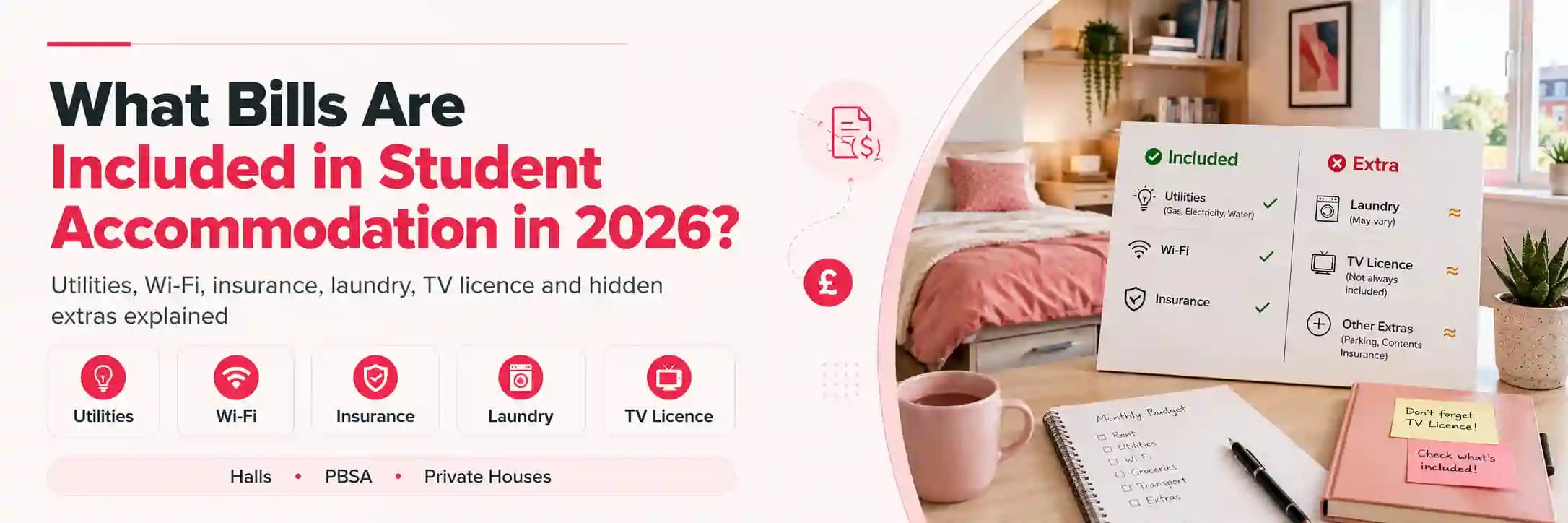
Bills are included only where the property confirms them. Some university halls and purpose-built student buildings include heating, electricity, water and internet, sometimes with fair-usage limits. Shared houses may exclude some or all utilities. Laundry, television licensing, parking, bedding and optional facilities may remain additional. Ask for a written breakdown of included services and usage conditions before booking.
Compare the total rent over the planned stay, holding or tenancy deposit, excluded utilities, internet, laundry, transport, food, household supplies and move-in purchases. Account for payments due before student finance and weeks charged when you may not occupy the room. Add travel to the exact campus, placements and part-time work. A lower weekly rent can become more expensive after transport and heating are included.
Begin comparing once the university, campus and likely start date are known, especially for September. Earlier research gives more time to compare Selly Oak houses, central halls and other areas, but students should not make an unverified payment. Confirm the room, current price, total cost, occupancy dates and cancellation terms in writing. Late applicants should widen the search and calculate transport.
Selected halls and private providers may offer semester, summer or other short stays, but availability is property-specific. Ask for the exact start and end dates, total cost, included bills, eligibility and cancellation conditions. Some short stays are limited to certain room types or periods. Verify that any sublet or replacement arrangement is authorised and obtain a written agreement before paying.
Student guides for Birmingham
Articles about living and booking student accommodation in Birmingham.